And why that is great news for independent builders
Two stories published the same week in March 2026 tell very different narratives about the future of software development.
Business Insider profiled Lewis Dickson, a 78-year-old retiree who vibe codes and keeps up with the latest AI advancements. He says technology gives him purpose. Being out of the workforce does not mean he cannot use AI like tech professionals.
The same week, Mike Cannon-Brookes (CEO of Atlassian, the company behind Jira and Confluence) went on the a16z podcast to defend SaaS companies against the rise of AI-powered development.
His main argument? Vibe coding is preposterous because of all the edge cases that lie beneath enterprise software.
Translation: Our moat is complexity. You cannot replicate decades of embedded business rules with AI.
One of these perspectives is right. The other is defending a collapsing business model.
Lewis Dickson, 78-year-old retiree: Uses AI to build software. Keeps up with the latest advancements. Says technology gives him purpose. Living proof that vibe coding works regardless of age, background, or technical experience.
Mike Cannon-Brookes, CEO of a $40 billion company: Says vibe coding is preposterous. Argues that enterprise software is too complex for AI to replicate. Claims edge cases protect SaaS companies from disruption.
Which perspective do you trust? The 78-year-old actually doing it, or the CEO trying to protect his revenue stream?
Cannon-Brookes did not go on the a16z podcast to talk about product updates. He went to do damage control on what the venture capital world is calling the SaaS Apocalypse.
Public SaaS companies have been hemorrhaging value. Investors are fleeing. And the reason is simple: AI can now do what SaaS companies charged billions of dollars to facilitate.
Throughout the 54-minute interview, Cannon-Brookes and a16z General Partner Alex Rampell tried to make sense of the market panic. At one point, Cannon-Brookes admitted:
There is no doubt in my mind that the risk level has gone up. If you think about it from an investor mindset, you are like this used to be a very stable category. Now it is a more risky category, hence I am going to step away and watch.
But then came the most telling admission of the entire conversation:
The whole history of software from 1960 until 2022 was you would take a filing cabinet and you turn it into a database. The cool thing about everything that is happening in AI land is that the filing cabinet can do work.
In other words: SaaS companies spent 60 years digitizing filing cabinets. They turned paper into pixels. But the actual work still required humans. Now AI can perform that work directly. The filing cabinet does not need a human operator anymore.
That is why Atlassian is scared. And that is why a 78-year-old retiree can now do what billion-dollar enterprise software companies charge thousands of dollars per year to facilitate.
Alex Rampell broke down SaaS companies into three categories based on how vulnerable they are to AI disruption. Understanding this framework is key to understanding why vibe coding is such a threat.
Category 1: Seats Tied to Outcomes (High Risk)
Example: Zendesk. Companies pay per customer service agent seat. But if AI can handle customer service tickets without human agents, revenue goes to zero. Rampell explained: If Zendesk just charges per seat per month for the current thing and never makes a change to their code or pricing, that revenue stream is 100 percent going to zero.
Category 2: Seats as Pricing Trick (Stable)
Example: Workday. Companies pay per employee, but those employees are not using Workday to produce an outcome. The seat pricing just feels fair. Rampell argued that Workday is fine because it is the system of record for HR data, and AI can only enhance it (by automating background checks, reference calls, etc.). The data stays in Workday.
Category 3: Hybrid Models (Unknown)
Example: Adobe. Some seats are tied to creative output, some are not. Pricing models will have to adapt, but it is unclear how.
But here is the flaw in this framework: It assumes AI cannot replicate the underlying business logic embedded in Category 2 systems of record. Cannon-Brookes and Rampell believe that decades of accumulated edge cases protect these companies.
That assumption is wrong. And a 78-year-old retiree is proving it.
When pressed on whether vibe coding could replace enterprise tools like Workday or Jira, Cannon-Brookes fell back on complexity:
I think vibe coding everything is just preposterous… because of all the edge cases that lie beneath. You do not know about them unless you have encountered them in the wild. A lot of software is just a set of deterministic rules that have been learned from decades of experience. The rules are embedded and you cannot just replicate them. You replicate them through experience.
His example: What happens in Indiana if a person leaves and they are on maternity leave? What about regional tax codes? What about local labor laws?
But here is what he is missing: AI is exceptionally good at handling edge cases through systematic testing.
One YouTube commenter explained it better than Cannon-Brookes did:
AI is very good at generating property-based tests for real world systems. You tell the AI to look at this process, and generate every conceivable edge case that could actually occur however unlikely. You have another agent walk through each case in your app and see what happens. You then have an agent fix the edge case. In time the accumulated edge case moat which was very real will get eroded. The risk is not that YOU vibe code a Workday. The risk is that 10 other companies build a Workday, use AI testing every case to demonstrate empirical equivalence but offer it for half the price and with a better AI first architecture.
The edge cases moat is not permanent. It is a temporary advantage that AI will systematically dismantle through automated testing, simulation, and iteration.
If a 78-year-old retiree can learn to vibe code, edge cases are not the barrier Atlassian CEO claims they are.
This is not hypothetical. Independent builders are already replacing expensive SaaS tools with custom AI-built alternatives. And they are documenting it in public.
Here are real examples from the YouTube comments on the same a16z video:
TXNRick: I got rid of QuickBooks fairly easy. It is bloated with a lot most do not use. Codex build me a QuickBooks and use Plaid for syncing bank and credit card. Pretty dang easy. Business customized software is going to be everywhere. I have rebuilt my full stack with only what I need. $1,500 per month down to a $40 per month Lightsail.
Mwasser: Jira is incredibly bloated. I vibe coded my own Jira alternative in 3 weeks, much simpler and easier to use. We moved everyone off Jira and cut out the per seat pricing. Now it is free permanently. I am not the only one who will do this.
peterfotinis4645: Everyone will vibe-code their own replacements from open-sourced well-spec prompts bespoke to their business. Specs to prescribe best practice and avoid common pitfalls. No compromise that comes with SaaS trying to cater for thousands of businesses. Bespoke well-specced and tested apps. A fraction of the cost to build and run. Running better for their business. With lower risk.
JuanPabloVasquezVillanueva: I do not know why I keep hearing that businesses will vibecode their own software and that is the threat. No they will not, but what is going to happen is that now you can start your own Workday, Salesforce, ServiceNow with way less cash and resources than before, and that is the threat. The next Workday, Salesforce, ServiceNow should be around the corner now.
These are not SaaS CEOs doing PR. These are independent builders proving Cannon-Brookes wrong in real time. They range from professional developers to 78-year-old retirees.
We are not debating whether vibe coding will disrupt SaaS. That debate is over. The builders replacing QuickBooks, Jira, and Salesforce have already settled it. The 78-year-old retiree using AI to build software has already settled it.
GAIDE Chicago – Greatest AI Developers Expo is gathering the people who are already doing it. This is the first invitation-only event in the United States designed specifically for vibe coders – independent builders using AI to create tools that replace expensive SaaS subscriptions.
May 22-23, 2026 | Chicago, Illinois
Friday, May 9: VIP Reception (6-8 PM)
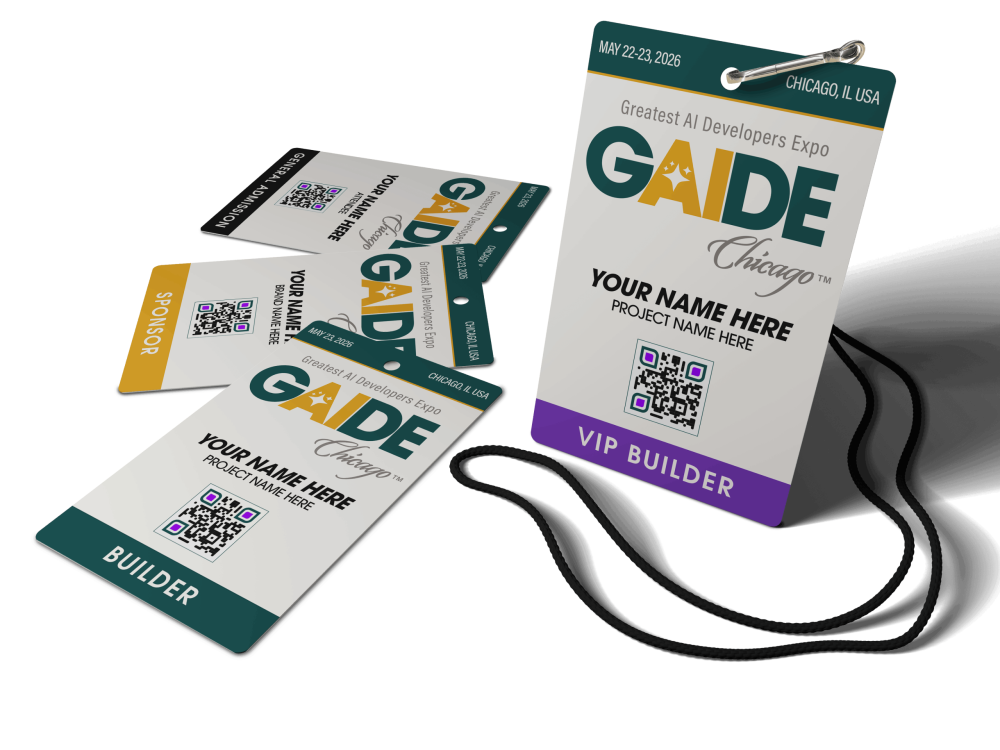
Meet the 15 VIP Demo Builders. Each VIP Builder Pass holder gets a dedicated demo table to showcase their AI-built project, premium personalized swag (embroidered hoodie, laser-etched water bottle, foil-stamped notebook), and networking with the top tier of vibe coders in Chicago. This is their night. VIP Builder Experience: $499 (15 Max ).
Saturday, May 10: Main Event (10 AM-5 PM)
Experience stage open to all VIP Builders. Showcase your AI-built projects. Cash prizes totaling $2,375 (1st place: $1,000, 2nd place: $500, 3rd place: $250, and five $125 runner-up prizes). Awards ceremony at 3 PM. BALOMMON community app launch at 4 PM (first 100 users get founder status). General Admission: $199 (100 spots total).
This is invitation-only. 100 spots total. VIP limited to 15. Registration closes April 21 at 11:59 PM CT.
No walk-ups. Everything is pre-personalized (notebooks, t-shirts, name badges, event catalogs – all with your name on them). Once the list locks on April 21, production begins. If you are not on the list, you cannot attend.
Atlassian CEO says vibe coding is preposterous. But the builders in the YouTube comments – and the 78-year-old retiree profiled in Business Insider — are proving him wrong every single day.
This is not about replacing every SaaS tool. It is about independent builders reclaiming control over the software that runs their businesses. It is about building bespoke tools tailored to your workflows, not bloated software designed to serve thousands of companies with compromises at every turn.
No VCs. No pitch decks. No per-seat pricing. No exit strategy.
Just builders showcasing what they built with AI. And keeping 100 percent ownership.
If you have already replaced a SaaS tool with something you built using AI, we want to see it. If you are building tools to solve problems that expensive software should have solved years ago, we want to meet you.
Request your invitation at gaidechicago.org before we hit the 100-maximum experience ceiling.
Because while Atlassian CEO is calling vibe coding preposterous, you are proving him wrong.
───────────────────────
GAIDE™ Chicago – Greatest AI Developers Expo
May 22-23, 2026 | Chicago, IL
A ZITNALTA™ LABS EXPERIMENT
 A ZITNALTA™ Labs Experiment
Dates: Preview Event
May 22-23, 2026
Location: River North
Chicago, Illinois USA
Experience Tiers:
VIP Builder: $499
Builder: $199
GA Support: $99
Are you a Builder? You're in the right place. Continue below.
General Admission → [Request GA Experience]
Sponsorship → [Request Sponsorship Experience]